Heart Rate is a Fuel Gauge

Every minute your body is active, it is burning a mix of fuels: Fat and Carbohydrates. The mix is not fixed- it shifts depending on how hard the body is working, heart rate is a simple, reliable window into that shift.
Here is what it looks like in practice:

Two patterns jump out:
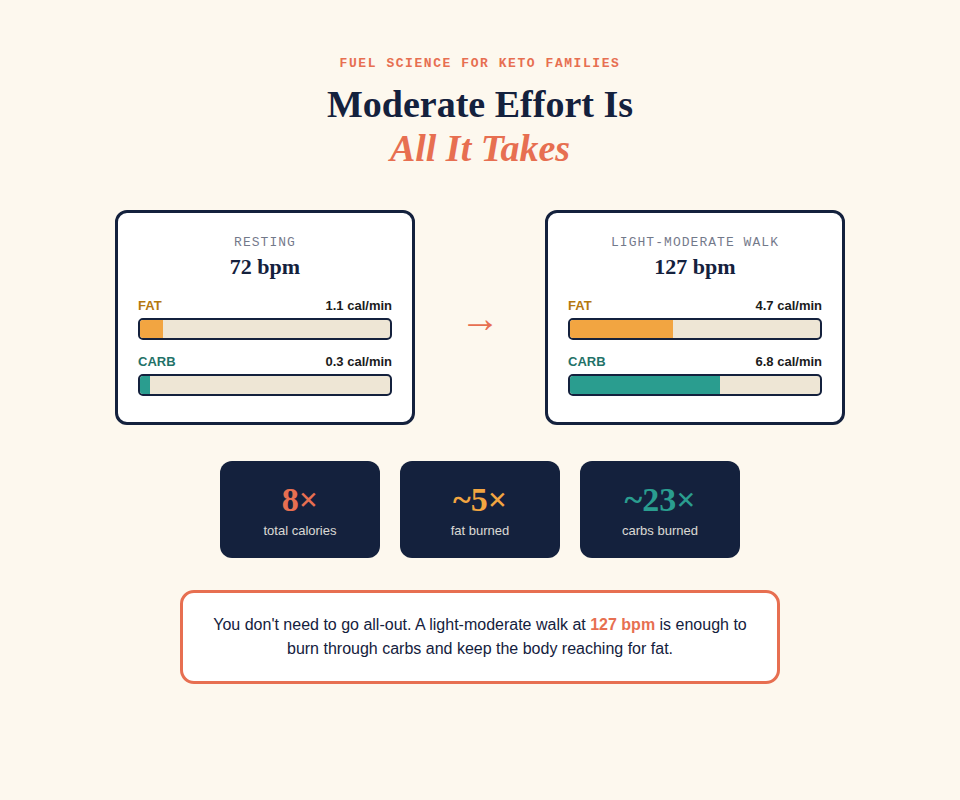
1. At rest, the body runs mostly on fat. At a resting heart rate of 72 bpm, about 78% of the calories burned come from fat. This is the body’s “default” fuel when demand is low, it’s efficient, and fat is abundant.
2. As heart rate climbs, the body leans harder on carbs. By 153 bpm, fat’s share has dropped to 27%, while carbs have climbed to 73%. Interestingly, the amount of fat burned per minute barely changes across this whole range (roughly 4.2–5.0 cal/min) — what changes is that carb burning ramps up dramatically to meet the higher total energy demand. Higher intensity doesn’t burn less fat; it just burns a lot more carbs on top of it.
Why this matters for keto:
This is where body fuel storage comes into the picture, and the numbers are striking:
- Fat stores: about 100,000 calories, banked away as body fat.
- Carb stores (glycogen): only about 2,000 calories, roughly 500 grams — 400 grams in the muscles and 100 grams in the liver.
That’s a 50-to-1 ratio. Fat is a massive, nearly inexhaustible reserve. Glycogen is a small, quickly-spent one.
The liver’s 100 grams of glycogen has a special job: it’s the body’s main tool for keeping blood glucose stable, and it’s the primary supply line to the brain. This matters a lot for kids on the ketogenic diet, because the brain is picky about its fuel, it can only run on glucose or on ketones, but it cannot use fat directly. When glycogen runs low and carb intake is intentionally restricted, the liver converts fat into ketones instead, which the brain can use as an alternative fuel. That ketone pathway is the whole foundation of why the ketogenic diet works for seizure management.
The takeaway:
Lower-intensity activity (walking, easy movement, resting heart rate ranges) draws fuel mostly from the body’s huge fat reserves and barely touches the limited glycogen supply. Higher-intensity activity pulls much more heavily on that small 2,000-calorie glycogen tank — which is exactly the reserve that keto families are managing carefully.
Understanding this isn’t about limiting activity — it’s about understanding why your care team may recommend certain intensity levels, and why the liver’s small glycogen reserve is such a precious, closely watched resource on this diet.
This post is for general education and isn’t medical advice. Always follow your child’s care team’s specific guidance around diet and activity.


Comments